Final Fantasy XII: A Heroic Review
Final Fantasy XII (FFXII for short) is a Playstation 2 title developed by Square Enix, a Japanese game developer most famous for developing RPGs such as the Final Fantasy and Dragon Quest series, as well as action RPGs like Kingdom Hearts. This game, like its many predecessors, is a sprawling JRPG featuring an epic story of politics and intrigue, a large roster of interesting characters and creatures, and the usual state-of-the-art (for the time, anyway) graphics and gameplay. In terms of gameplay, the highlights are the unique blend of real-time and turn-based combat, the changeover from specialization with jobs to customizations via licenses, and the introduction of a mechanic that allows for the automation of character actions called gambits.
For clarity, a JRPG, or Japanese roleplaying game, is a subgenre of RPGs that come out of Japan that are known for being complex and anime-like. These games require players to figure out the best combinations of equipment, spend lots of time grinding to level up and collect resources, and usually feature epic stories that revolve around possible global destruction. Square Enix’s Final Fantasy series is a prime example of this genre.
The story takes place in Ivalice, a large fantasy world. This world has access to magic, through a strange phenomenon called “Mist”. Mist, made solid as the mineral Magicite, powers Magick (it’s not a JRPG if something isn’t spelled funny) as well as technology in Ivalice, allowing for massive airships existing alongside teleportation, the two means of fast travel in the game. Two major political powers exist on this world: the Rozzarian Empire that rules the continent of Ordalia, and the Archadian Empire that rules the continent of Valendia. Two smaller countries appear in the game as well: Bhujerba, a technologically advanced neutral state due to an abundance of magicite, and Dalmasca, a small kingdom located between the two empires that is home to the majority of the main cast and where much of the action takes place. At the beginning of the game, Archadia has taken control of Dalmasca.
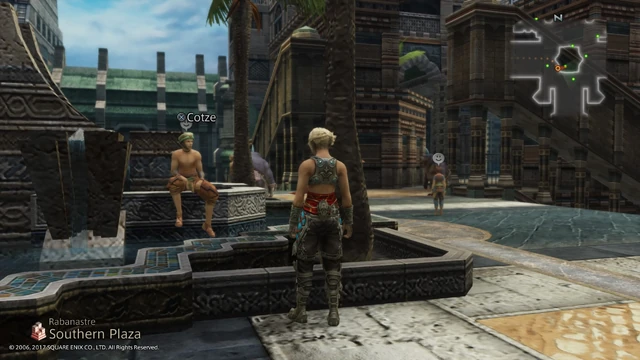 |
| It looks nice, but rent is brutal. Taken from PS2 (C) Square Enix |
There are six playable characters in FFXII. Vaan, a Dalmascan orphan, dreams of leaving the drudgery of his life and becoming a sky pirate. Penelo, Vaan’s childhood friend, has the most common sense of the two and travels with Vaan to keep him out of trouble. Basch is a Dalmascan knight who has fallen from grace, as during the prologue of the game he is framed for the death of the Dalmascan King, Raminas. Balthier and Fran are sky pirates who become inadvertently entangled in the plot, and crew the airship Strahl. Finally, Ashe is the daughter of Raminas, the deceased Dalmascan King, and leads a resistance against the Archadian Empire.
 |
| Like Friends, but kawaii. (C) Square Enix |
There are a number of different species in Ivalice, besides humans, who are referred to as Humes in-game. Fran, one of the playable characters, is a Viera, a humanoid creature with rabbit-ears and more claw-like appendages. There are also other less human-like sentient species, such as the Bangaa, who are massive lizardfolk with snouts and tails. Yes, this game also has Moogles and Chocobos. It's a Final Fantasy title, after all.
The story is captivating, and still interesting today, twelve years after the original game came out. War is a major theme, especially the losses incurred in war and the questionable choices made by both sides. Another major theme is conflicting loyalties between family and country. Ashe is torn between hating Basch for allegedly killing her father the king and working with him for the sake of Dalmasca. We are also introduced to two brothers in conflict: Vayne Solidor and his younger brother Larca. While both are princes of Archadia, Vayne is the consul of Dalmasca on behalf of the Archadian Empire and a tactical genius who wishes to exercise further power in Ivalice, but Larca seeks peace and believes in his noblesse oblige to resolve all the conflicts.
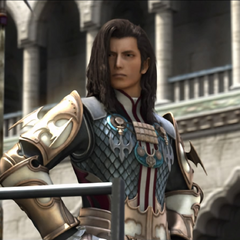 |
| Vayne Solidor. I know he's the bad guy, but look at that HAIR. Source: PS2 (C) Square Enix |
Gameplay can be divided into two aspects: combat and non-combat. Combat, as I mentioned before, is both real-time and turn-based. FFXII innovates combat in relation to previous entries in the series. Older Final Fantasy games featured random encounters that pulled players into a different battle arena screen. However, the “Active Dimension Battle” system used by this game means that there is no distinction between exploration and combat. Enemies are visible as the player moves through an area with their party and players enter and leave combat seamlessly. When the party approaches an enemy, colour-coded lines indicate the target of an action, and a charge bar fills up to indicate the amount of time until a character takes their action.
What actions are available to characters is determined by Licenses. As the player’s party defeats enemies, they pick up License Points (LP) and they spend that LP to unlock licenses on a board. Unlocking these Licenses allows characters to use new weapons and armour, learn new Technicks and Magicks, and even increase the effectiveness of healing items. Eventually, characters can unlock powerful moves called Quickenings, which send the player into a quick-time event where they must press buttons to keep a streak going. The longer the streak, the more damage the move eventually deals.
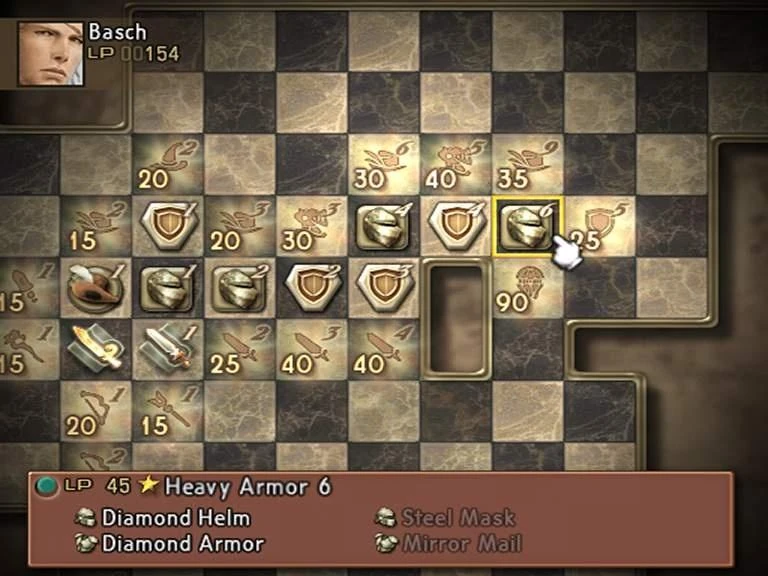 |
| Grinding for LP can be tedious, but it's better than waiting for your driver's license Source: PS2 (C) Square Enix |
While players may want to choose the actions of the characters, this can become extremely challenging in real-time. The game therefore provides a different way of setting character actions in the form of Gambits. In the Gambit menu, players can set up and rank a number of if/then statements that describe actions the character can make. The AI will move through the ranked list and attempt to take the actions if the right conditions are met. By doing this, players can focus on controlling one character while the others do things independently. Some players and reviewers aren’t a fan of the Gambits, however, because you can enter a combat, put the controller down, and leave your anime Roombas to fight while you make yourself a snack.
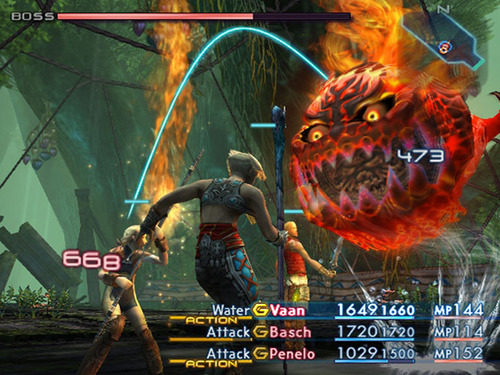 |
| Remember, you're picking this fight in real time. Source: PS2 (C) Square Enix |
The game does not immediately play itself, though. Players get the ‘if’ clauses from merchants as well as chests scattered around levels. Players also find other items in chests like potions and Gil (the in-game currency), but to truly make enough Gil to shop, players collect “loot” from monsters they defeat and sell them to the merchants. With the Gil they’ve now collected from selling to merchants, players can not only buy Gambits, but also buy equipment such as weapons and armour as well as new Magicks and Technicks (non-magical abilities),
Shopping is part of the non-combat aspect of the game. The other aspects include talking to NPCs and exploring towns. By doing these things, players can find secrets hidden in the town, complete sidequests, and learn more about the wider world of Ivalice, and the more localized parts of the world they visit. Final Fantasy XII is filled with interesting NPCs just waiting to tell players exactly how they feel about the state of politics, the weather, and their drinking habits, and this adds spice to an already flavourful world.
 |
| Drink responsibly, kids. Source: PS2 (C) Square Enix |
Handling these aspects of the game via the PS2's Dualshock 2 controller is simple. Controls are intuitive and well-explained. This was the era of games being sold in a box with manuals, so players always had access to a document to refer to how controls worked. This was also the era of bad cameras, however, and navigating the camera with the right analog stick can sometimes feel like a chore, especially in the middle of a fight. Otherwise, moving through the game is easy, and navigating the various menus players find is equally simple.
When the player interacts with NPCs in this way, the dialogue is delivered via text. When players are involved in plot-relevant cutscenes, however, the dialogue is voiced. The voice acting, for the most part, is stellar. The voices of the player character party are excellent, and the voice actor for Balthier, Gideon Emery, absolutely owns the part of fancy Han Solo. However, there are a few misses. Fran’s voice acting can be stilted and emotionless, and Marquis Ondore, the ruler of Bhujerba, has the strangest accent I have ever heard. It is a mix between an Indian accent, an Arab accent, and a vaguely European accent. All this from a character who would be best described as tanned. This is especially unfortunate, given that Marquis Ondore is the game’s narrator. It’s not Tidus laugh levels of uncomfortable, but it still manages to grate, especially for me as a South Asian man.
While the accents can sometimes be strange, the actual dialogue is rather enjoyable. Vaan and Penelo spend a lot of time bickering, but it is cute and childish, a pleasant reflection of their long relationship. Basch’s lines reflect the tragic hero persona well, while Ashe moves between powerful rebel leader and genuinely scared teenager smoothly, without causing disbelief. Truly though, Balthier has the best lines. I mentioned earlier that his voice acting is great, but it shines all the more because the dialogue he delivers is so cool.
 |
| Vaan is SUPPOSED to be the main character, but look at this guy. LOOK AT HIM. Taken from Tumblr. (C) Square Enix |
The game, for being a PS2 title, is stunning to look at. FFXII uses both pre-rendered and on-the-fly cutscenes, and the pre-rendered scenes are of the same high-calibre work that Square Enix has come to be known for. The on-the-fly cutscenes, using the in-game graphics, are pleasant to watch, but it is obvious that the game has been dubbed in English and was originally in Japanese, as there are times when mouth movements don’t sync. Nor do the subtitles, in fact. This is truly an artefact of the game’s age, since technology in 2006 is not really comparable to what we have now.
Outside of cutscenes, the graphics are enjoyable. Characters move smoothly, environments are dynamic, towns are architecturally interesting, and the areas outside of towns are large and varied. These areas are animated such that distant parts of the map yet to be explored can be seen on the horizon, which adds depth to the world. My only complaint is that colours tend to be washed-out, drab shades of brown, which is fine for desert settings, but feels lacking elsewhere, especially in the towns.
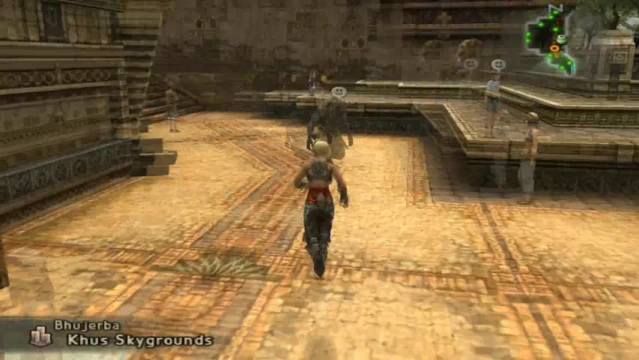 |
| Your city is nice, Marquis Ondore, but a little paint wouldn't hurt. Taken from PS2 (C) Square Enix |
The ESRB rating is T for Teen. This is an appropriate rating in terms of content, but in terms of difficulty this game would not appeal to every teen. Final Fantasy games target ‘hardcore’ gamers, and that audience actively seeks challenging games.
All told, I love this game. I’m attached to the world and the characters, especially Balthier and his roguish charms. I like the mechanics, I like the music, I like the game as a package. I would rate this game a 9/10. That last mark is lost because of what I described above, and because of Fran’s costume. While both Penelo and Ashe have reasonable clothes on, Fran is essentially wearing black lingerie, which is incredibly uncomfortable and does not hold up in today’s gaming culture, which is shifting to better representation of women, especially women of colour. I also wish the more humanoid characters, both player characters and NPCs, were more diverse in terms of skin colour. Only the Viera have dark skin, while all the Humes are white or tanned.
Consider this a positive review, though. Play this on your PS2, or pick up the HD remaster for PS4: Final Fantasy XII: The Zodiac Age.
Comments
Post a Comment